Wednesday, March 30, 2011

The Indwelling

There's not much to say about The Indwelling. It is the 7th book of the popular Christian fiction series Left Behind. I'm reading the series (slowly) because I never have and because sometimes my brain needs a break. I read a lot of deep and dense books and if I don't read mindless easy-to-read fiction books from time to time I go on information overload.

If you've read one Left Behind book, you've read them all. You know what to expect: fast-paced action, precarious situations, the heroes (usually) beating almost impossible odds, and a very black-and-white good versus evil battle. Maybe even a slight twist. All of that's here, except the twist. This book is a bit different in that it takes place over only about 3 days. It's still fast-paced, just a bit more subtle than the previous books. It allows for a minimal amount of character development for Chloe and Rayford in particular, which is nice because their characters have gone through almost no development since the midway point of the first book.

I can't really talk too much about the book because it might contain spoilers. A character gets "saved," another dies, and the Carpathia administration makes one more step in its opposition to the Tribulation Force.

Overall, the plot is predictable, the characters still flat (I haven't built a connection with any characters yet), and the writing at a middle school level. It's popular fiction with a very obvious Christian slant.

In A Sentence: Lots of action but it loses its punch when you account for the fact that it's hard to relate to or connect to the overly flat and stereotyped characters.

Rating: 2 out of 5 stars (for being my favorite left behind book since the first)


Book completed March 28th...6 books, 28 days...at this rate I'll read 78 books

Saturday, March 26, 2011

In Defense of Food

I don't have much to say about Michael Pollan's In Defense of Food. It is a study of nutrition and ultimately a defense of "whole foods," or foods in their original form, sans unnatural nutrients, lab-created additives, or corn or soy based substitutes. It's an interesting look at how the food industry uses nutrition fads to sell all kinds of "pseudo-food" that are essentially lab creations: breakfast cereals, boxed pastries, most bread, snack foods, etc. Fritos can make claims about being "heart-healthy" because of some crazy loophole - having just enough whole grains and unsaturated fats that the FDA can say that it has "weak and uncertain evidence that this product when eaten in place of foods with higher saturated fat contents might reduce the risk of heart disease" or something very similar to that.

Most interesting are the parts in which he deconstructs the fat bias our culture has, to the point where all fat is bad, which is absolutely contrary to all research. Trans fats are certainly bad (and research shows it) and saturated fats are probably a little bad (research shows), but most other fats are actually really good, and without them our health declines. He jumps from this to show how the food industry has been so incredibly influential in taking over supermarkets and now is even creeping into the realm of medicine. With all the health claims they make, they have even shaped how doctors recommend diets for people with heart conditions. No-fat foods, non-red meats, and whole grains are all big items for people with heart conditions when in fact, there's little science behind all of that. Pollan argues that what people with heart conditions really need are whole foods: plants, whole grains (without all the extra additives), and only a minimal amount of meat. Meat is meat, and while red meat is not as good for you as other meats, if you substitute a large chunk of red meat with a large chunk of white meat, you're really not much better off, especially if it's in the form of bacon or a hamburger.

In the end of the book, he proposes several "food rules." These are quite interesting and serve as great guidelines for eating.

This book is a good read, but I would only recommend it to a small portion of people. If you really want to learn about the food industry, healthy eating, and sustainable foods, then read Pollan's Omnivore's Dilemma, which is a fantastic book. It's a lot longer and more in depth than In Defense of Food, but it's worth it. If you Omnivore's Dilemma seems too daunting, then give Ominvore's Dilemma for Young People a try. It's geared toward teens, but is still an excellent read. Or, you could watch Food, Inc., a riveting documentary on the food industry that Pollan contributes to. If you just want rules and guidelines in an easy-to-read form, then pick up Pollan's Food Rules. I'd only recommend In Defense of Food to people interested in nutrition but unsure of where to start, or people who have read Food Rules who would just like a little more background information. Otherwise, stick to the other books. They are either better or more functional.

In A Sentence: A well-written and well-researched look into the food industry and nutrition, but ultimately just an attempt to cash in on the success of Omnivore's Dilemma.


RATING: 4 out of 5 stars


book completed March 24...5 books, 24 days...at this rate I'll read 76 books

Monday, March 21, 2011

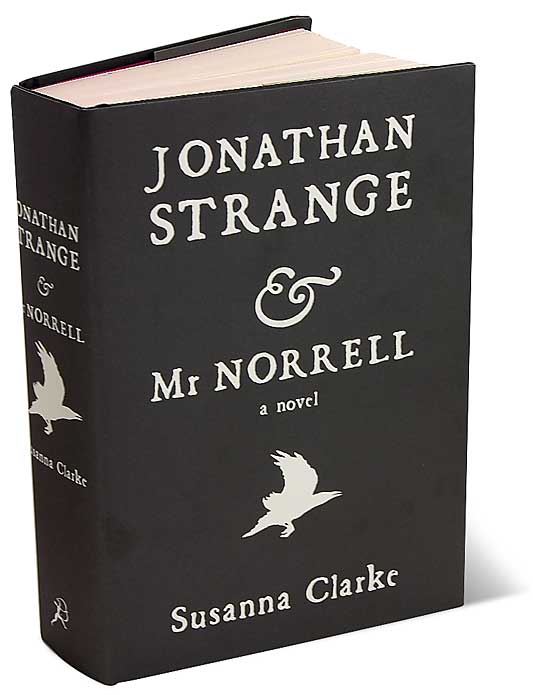
Jonathan Strange and Mr. Norrell

I am on a roll. Just leading into the start of my challenge I had read almost entirely disappointing books. Not all of them were bad, some were still pretty good, but nothing worth re-reading. I had read maybe one or two 4-star or above books in the time from Christmas to the second week in March. Now, I have read my third straight awesome book and another one waits for me on my shelf.

OVERVIEW:
This book is Jonathan Strange and Mr. Norrell by Susanna Clarke. It's an intimidating book at 782 pages and it's not an easy read, either, like the Harry Potter books of similar length. If you like to read good, rich books, then it's WELL worth the time and effort. It's one of the ten best books I've ever read.

This book is a classic. It holds up to the standards of Dickens, Austen, Tolkien, and other fine English writers. In fact, at times, it felt as if I were reading a classic piece of literature from the 19th century, not a modern fantasy written in 2004. Equal parts thoroughly researched historical fiction, enthralling fantasy, and subtle comedy, Clarke weaves a tale that is both thoroughly engrossing and exhiliratingly astonishing. The only book I have ever read that has met these standards is The Count of Monte Christo, although there are a few other books of equal quality and strength for other reasons.

Quick Summary:
In this alternate-reality England, magic, which was once prevalent, is now all but gone. The sole remaining "practical" magician is Mr. Norrell, who doesn't care much for public displays of magic but hopes to see it increase in its prominence, particularly in government. His greatest treasure is his library, filled with nearly every magic book in creation. He eventually takes Jonathan Strange under his wing to train to be a second magician. He quickly becomes Norrell's equal and they spread the love of magic throughout the island nation. However, the Faerie world (often invisible or hard to get to) grows in strength as a result of all of the magic, and a particularly devious faerie makes it his goal to anoint a new magical King to rule over England, and will stop at nothing to achieve this goal. Strange and Norrell are forced to choose to embrace these new changes or oppose them, although no matter their choice, they will fail. Or will they?

That's really REALLY simple. There is so much complexity to this book that it is impossible to sum it up in one paragraph. Honestly, that's a terrible summary. Any summary of less than 10 pages is probably terrible. But you get a taste.

The Good Stuff:
Beyond what I've already stated, this book has a very rich mythology/alternate history. Not quite at the scale of Lord of the Rings or Chronicles of Narnia, but better than Harry Potter. The characters are extremely well-developed and quite real. Humor is interspersed and often hits you by surprise. I laughed out loud on a few occasions, but you have to pay attention to find the jokes. I also like how magic was handled. Unlike many magical fantasies, it does accommodate the Christian faith decently well, and does discern between good, evil, and "neutral" magic, where good "magic" comes from God (see: Moses), "neutral" magic comes from faeries (sort of), and "dark" magic comes from Hell.

The Bad Stuff:
Not much honestly. It's long, deep, richly written, and quite an investment. I could see how some people could have difficulty reading this or might find it boring. If you can handle it, it's an awesome book.

For Fans of: Fantasy in general, Charles Dickens, the Lord of the Rings, Harry Potter (if you're longing for something deeper and richer than that)
Don't read this if: you prefer easy reads; you are a super-fundamentalist Christian who can't stand the word "magic"; you absolutely detest magic and fantasy to the point that you don't like "A Christmas Carol"

In a Sentence: I'm going to have to quote Neil Gaiman: "Unquestionably the finest English novel of the fantastic written in the last 70 years." Although I'd say 50 rather than 70 (Lord of the Rings might be better) and I'd get rid of the word "English"
Rating: CLASSIC (beyond the star system. honestly.)


4 books, 21 days....at this rate I'll read 69 books.

Sunday, March 13, 2011

The Orchid Thief

Yesterday, I did something I haven't done for a long time: I sat down and read a book cover to cover in one day.

The book? The Orchid Thief, by Susan Orlean. This book may be familiar to those who have seen the movie Adaptation, which is based on this book. I've been looking forward to reading this since I picked it up 6 months or so ago at Half Price Books for $0.50. I love the movie, I love orchids (although I know very little about them), and I love books.

The book follows Orlean as she explores the world of orchids. About half of the book revolves around John Laroche, an orchid cultivator who went on trial for picking wild orchids, a crime in certain parts of Florida. The movie version depicts Laroche just as described in the book: a wildly obsessive and intelligent man who carries the physical form of a redneck. An unlikely hero, Laroche jumps from obsession to obsession but completely immerses himself in whatever he decides to be collecting at the moment. As odd as he seems, we soon realize that most true orchid lovers share much of his qualities.

The other half of the book goes into various background information: the history of orchid hunting and cultivation, scientific information about how orchids live, grow, and reproduce, and even a history of Florida itself. While this may seem like a diversion from Orlean's quest to learn about the very mechanisms that drive orchid passion, they play a key role in describing several "characters" that play a key role in the book: the Florida wetlands, the orchid itself, and passion.  All three are intertwined and ultimately serve as the true subjects of the book despite Orlean's untiring inquisitiveness and Laroche's quirky charm.

Orlean proves her mastery of the writing form through this book, seamlessly transitioning from informational writing to narrative with equal mastery in each style. She is able to tie everything together in a way that creates a compelling work. The Orchid Thief wound up being a very satisfying one-day read.

For fans of the movie, don't expect anything weird from the book. Adaptation is a wonderful movie, but it breaks from the book in many ways. Everything with the "Charlie Kaufman" character (played by Nicholas Cage) is purely fictional, as is everything in the movie between Laroche and Orlean after you find out that Laroche's passion has switched from orchids to pornography (that's not really a book or movie spoiler...you are told from the outset that Laroche jumps from passion to passion). The first half of the movie, however, sticks very well to the book.

Rating: 5 out of 5 stars (yeah, I know I said this would rarely happen - and now it's been 2 out of the three books so far!)
In A Sentence: The Orchid Thief is a masterful book about orchid passion that immerses you in the topic and then spits you out, yearning for more.


3 books, 12 days...at this rate I'll read 91 books.

Friday, March 11, 2011

Winter World

Wow. It has been quite some time that I have read a book that is this compelling and well-written. Winter World: The Ingenuity of Animal Survival by Bernd Heinrich is not just a science book - it's an experience. 


The book focuses on adaptations animals make in the winter to cope with extreme cold. Heinrich explains this through a style that feels at times like poetry and at others like a long personal narrative. He walks you through his experiences, his adventures, his careful and meticulous studies while making you feel as if you were a part of his journeys. 


Winter World is not an exhaustive informational book. You won't find yourself using this to find specific information. However, sitting down and reading this book is nearly as fulfilling as going outside and doing the work yourself. Heinrich is able to convey information through his storytelling. You can read this book and understand it without an extensive science/biology/environmental background.


As Heinrich walked me through his winter wonderland, looking at everything from kinglets to bears to snapping turtles to bees to deer mice to badgers and so on, I found myself enthralled and compelled to continue flipping through the pages. He draws you in with a story and then slowly delivers more specific information.


I learned quite a lot about the winter life of wild animals through reading this book. I was also quite well entertained. This will likely be one of the top ten books I read this year. I particularly enjoyed the author's focus on birds (about half of the book was devoted to the case study of the kinglet). Some parts are a bit weird, but it's all part of the fun. The author is quite the naturalist - he counts feathers in a nest, searches for bird droppings, examines the stomach contents of roadkill, and more - but it's all part of his passion for inquiry. A passion that finds itself rubbing off on the reader.


Rating: 5 (out of 5) - you won't be seeing this very often!
In a sentence: Enthralling presentation of the winter life of animals for scientists and lay people alike.


11 days, 2 books...at this rate I'll read 66 books.

Thursday, March 10, 2011

Paladin of Souls


(book completed March 6)
I have to force myself to read fiction. Otherwise I'll read non-fiction book after non-fiction book until my brain is bursting with so much interesting information that I either A.) Forget everything I learned; or B.) Become burnt out with reading. Now I'm working through the Hugo award-winners that are available through the Penn Hills Library. The Hugo Award goes to the best science fiction or fantasy book of the year. Typically it's Sci-Fi.

Unfortunately, very few high-quality science fiction and fantasy books have been written since the 1970s. I have found many of the winners to be poorly written or distractingly out of date. Really good science fiction should be relatively timeless, even if some things didn't quite work out the way they were written. (see HG Wells, Phillip K Dick, CS Lewis, Jules Verne). I have been growing tired of some of the weak Sci-Fi books on the list and was looking forward to this book, a rare Fantasy Hugo-winner.

For this selection, I read Paladin of Souls by Lois McMaster Bujold. The story is actually a sequel, which I did not discover until after I finished it, but you don't really need to know the original story to know what's going on. You may need it to better connect with the characters, because I found them to be extremely flat and boring.

The story revolves around Ista, a queen trying to escape her homeland. She travels along with a small group of followers and helpers. Along the way they encounter demons that possess others, a rival tribe that captures them, mysterious half-brothers, and eventually encounter the force that is behind much of the evil in the book. It's farely fast-paced, but not as compelling as one might hope.

The fantasy element of this book is its mythology. The religious system of this book is based on a five-god system, where different rival tribes follow different gods. There are also "saints" and demons. Ista is a "saint" and can detect the presence of demons and can peer inside of others' souls. She spends parts of the book in dreams, which all play a part in the larger story. Demons are evil spirits that possess animals or humans. They can travel from one body to another, but only sometimes. Additionally, there are sorcerers, who harness the powers of demons (they are typically possessed themselves) and weild great power.

The book itself is decently written, particularly for modern fantasy/scifi. The problem is in the characters and the mythology. Perhaps I'm missing something from not having read the first book, but I just could not connect to the characters. They seemed flat and uninteresting. Character development is almost absent, and I found myself not really caring about their fates. The mythology was not well developed or explained, seeming very generic and extremely inauthentic. It's hard to see why the characters in the book would be so devoted to the gods they follow.

Rating: 2.5 out of 5 stars
In a sentence: You know what you like - if you like this kind of book, you'll like this one, but if you don't it would be best avoided.


so far...6 days, 1 book...at this rate I'll read 66/100 books (my pace will pick up in the summer)